
Proposal : Whitby 20mph scheme
Residential areas should be places to relax, and mix with neighbours. Town centres should be places for the community to meet. Society became car dominated years back, and roads determine how a residential area feels to its occupants. Using a 30mph speed limit in a strictly residential area is a danger to pedestrian and cyclist safety, even though it became the fallback option many years ago. Figures from the Welsh Government show that the first 2 years of the default 20mph resulted in 1,270 fewer people being injured on urban / village roads in Wales, a 26% reduction. Nowadays we have cars parked in the road in residential areas, meaning that there is not a free flow of traffic anyway, hence even less need for 30mph as being the default.
Currently all primary schools offer Level 1 and 2 Bikeability training for children, however the absence of cycle paths close to home means they have nowhere to feel safe using what they have learned. Parents have understandable reticence in allowing them out on bikes for this reason. Additionally, they are also deprived of the chance to cycle to school – something with proven benefits to educational results. We also have almost double the national average of over 60s, and reaction times suffer with age, resulting in difficulty getting across roads.
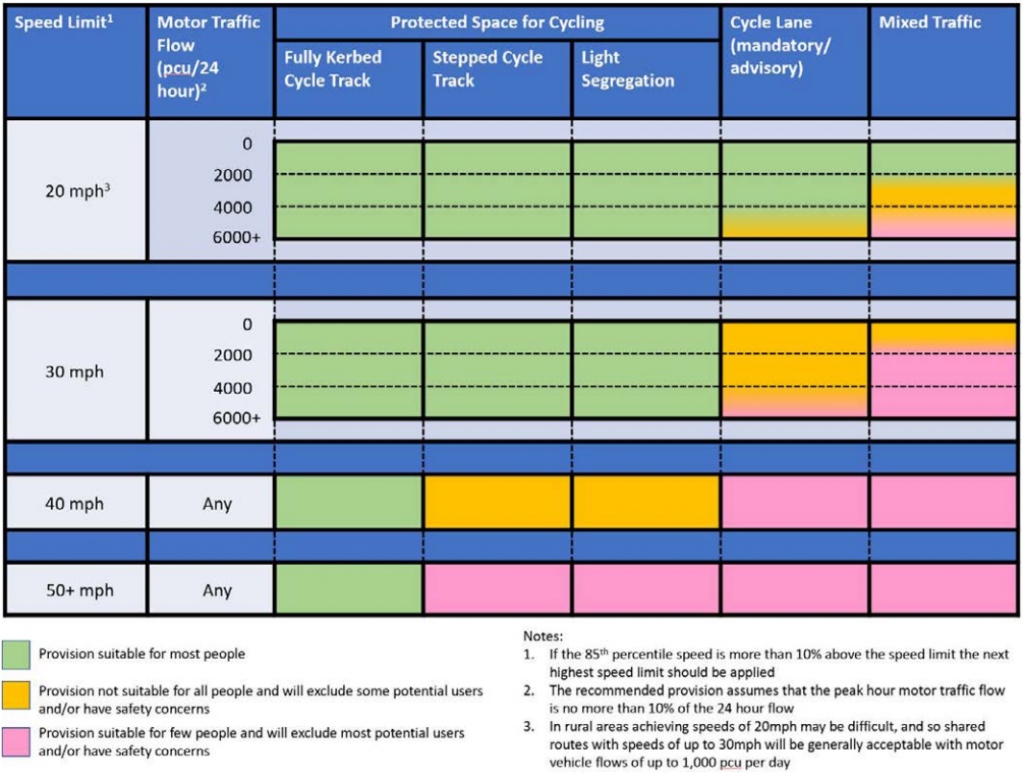
Whilst providing cycle paths (whether shared or segregated) is possible in some areas, we accept that it is sometimes impossible to retrofit cycle infrastructure to some existing areas, where road space is limited or there are no suitable greenways to utilise, and this particularly applies in residential areas. The fact is that even in a 30mph area, the majority of people consider riding a bike on a road as dangerous (see UK Government LTN1/20 guidelines), and exemplified in the figure below from that report (what cycle infrastructure to provide based on the road conditions) – for a low traffic road and for bicycles to be in “mixed traffic” (i.e cars and bikes together on the road, no bike segregation) the speed limit has to be 20mph for it to be considered “safe”, otherwise a cycle lane of some form would be needed, so it would be simplest / cheapest to avoid this infrastructure imposition in residential areas.
The Proposal
The overall proposal is that all residential areas, as well as the town centre area, should be 20mph zones, using a signage-only implementation.
Whilst we would like to include the space outside all schools, perhaps just during school arrival/leave times, current NYC policy seems to be rejecting such proposals when the road is a primary arterial route, so we will leave that aside for now. [In the case of Whitby New Bridge, when a request for 20mph was received from an NYC Area Committee, the reply was “The A171 is part of the primary route network and daily traffic volumes are high with approximately 16,000 vehicles per day using this section of the A171 in the summer months. Given the importance of this primary route, it is highly likely that a 20mph speed limit will adversely impact on traffic flows and receive negative feedback from motorists.“].
The proposal complements the Whitby Active Travel Plan / LCWIP, with that document defining travel between areas, whereas this proposal assists active travel within areas (such as within a residential estate). This means that, in principle, people can cycle on roads in their residential area with a level of safety without the need for specific cycle infrastructure over the relatively short distances needed, and pedestrians would be safer also due to the lower traffic speeds.
The UK Government recently adopted the Safe System approach, which implicitly requires 20mph speed limits within urban / village areas, where people are. Consequently implementation of this proposal is totally consistent with DfT strategy, and indeed DfT guidance will eventually be updated to require 20mph in residential zones.
The overall proposed implementation of 20mph is shown on the map below.
In terms of prioritisation, we are targeting residential here, given that it will yield the most significant difference for people’s lives. So the zones are considered in the following order :-
- Residential : marked all residential estates as 20mph (light blue for Whitby West, and dark blue for Whitby Streonshalh) – Abbots Road/Walk and Fishburn Park already are 20mph;
- Town Centre : expand the current town centre 20mph zone (yellow) to reach the end of Bagdale, Flowergate, Skinner Street and St Hilda’s Terrace. Given that there already is a Town Deal project awaited on this area we are leaving it until after the residential areas, and besides this area would be better tackled as part of town centre regeneration / pedestrianisation;
- West Cliff : whilst not exclusively residential per se, it is the location of many hotels, B&Bs and holiday lets as well as the destination for many tourist attractions so should be a lower speed zone.
- Whitby Business Park : significant numbers of people visit the retail outlets on the main road, and the Whitby Business Park action plan aims to promote sustainable modes of transport in getting to / from all outlets, so should be considered for 20mph also.
Whilst there is evidence that including arterial roads (such as Mayfield Road, Upgang Lane, Stakesby Road, Love Lane etc) in such schemes is effective, we have omitted these from this proposal so that we focus on something providing direct benefit but minimising the overall impact on road users.
Benefits of the Proposal
The rationale behind this 20mph proposal is
- Safety : This would reduce the likelihood of any road collisions between motor vehicles and pedestrians / people on bicycles (2/3 of all serious collisions with people happen in 30mph zones). There are ample reports describing the safety benefits of a 20mph speed limit, such as this one from ROSPA, this one in the BMJ, as well as governmental analysis of the effectiveness. Roadwise UK estimate that the mortality rate for a pedestrian from a collision at 20mph is 2.5% whereas at 30mph it is 20%. Given that road collisions involving pedestrians or cyclists are on the rise, and that 20mph could significantly reduce this, it should be a high priority for highways authorities. You can view road collision report history for North Yorkshire on this page.
- Reduced pollution : Healthier places to live. Tests have demonstrated reduced emissions (CO2, Particulates and NOx) by moving to 20mph.
- Reduced road noise : Makes neighbourhoods more pleasant places without the drone of traffic. Tests have shown that there is typically a 3dB reduction in noise by going from 30mph to 20mph.
- Promote cycling : It would make it more viable to utilise a bike within that area, as part of getting to a cycle path, and also children can make use of their Bikeability training and gain confidence in their own areas before going out on to bike paths.
- Cost effective : It would mean the provision of physical cycle infrastructure in those areas (and in the majority of existing residential areas the roads are too narrow to provide infrastructure) would be reduced. Dropping a speed limit from 30mph to 20mph is significantly cheaper than providing bike segregation, particularly with a signage only scheme. Deployment across the UK has shown that this typically costs between £3 and £5 per head to implement, a one-off cost that pays for itself in months due to lower collision rates and fewer potholes.
Quantified Benefits : If we took something like all Whitby Streonshalh estates listed for example, there are more than 1300 dwellings affected, which equates to (assuming 2.3 residents per dwelling) going on for 3000 residents. All of these residents would gain from a calmer residential environment, with improved safety for pedestrians, people on bikes, and for children playing.
Cost of the Proposal
This will be defined by NYC, and will depend on how manu residential estates are submitted. The aim was to submit a funding bid to the Y&NY Mayors Active Travel Fund for the defined amount.
The proposal could include all or a subset of the listed residential areas. This would be for NYC to advise.
Design
To establish the suitability for 20mph, with the NYC policy we would need to demonstrate that speeds are not so far from the desired 20mph to start with. This would be via a speed survey in a representative road in the zone. In the table below we have listed the likely number of speed surveys needed for each of the proposed zones.
Regarding the actual implementation cost for a signage only scheme we firstly need to calculate the number of entrances to each zone. We are then assuming the following at each zone entry/exit point.
- 2 posts (1 either side of the entrance / exit).
- Each post will have a “20mph” sign on one side and a “30mph” sign on the other side.
- “20” with circle painted road marking across the road.
It is worth noting that it probably would be impractical to implement this across all areas in one phase, as a result we would consider input from NYC re what phasing they would recommend.
The final column gives the scope of the approximate number of dwellings in each residential estate, so as to judge the impact.
| Zone Name | Likely No of Speed Surveys | Number Of Entrances | Number of Posts | Number of 20mph signs | Number of 30mph signs | Number of 20mph road Marking | Approx Num Dwellings |
|---|---|---|---|---|---|---|---|
| Eskdale / Larpool | 2 | 5 | 10 | 10 | 10 | 5 | 623 |
| St Peters / East Whitby | 1 | 2 | 4 | 4 | 4 | 2 | 206 |
| Meadowfields | 1 | 1 | 2 | 2 | 2 | 1 | 90 |
| Green Lane | 1 | 2 | 4 | 4 | 4 | 2 | 276 |
| Whitehall | 1 | 3 | 6 | 6 | 6 | 3 | 146 |
| Stakesby | 1 | 10 | 20 | 20 | 20 | 10 | 890 |
| Sneaton Castle | 1 | 2 | 4 | 4 | 4 | 2 | 236 |
| Castle Park | 1 | 5 | 10 | 10 | 10 | 5 | 500 |
| White Leys | 1 | 10 | 20 | 20 | 20 | 10 | 600 |
| Mayfield Road North | 1 | 2 | 4 | 4 | 4 | 2 | 166 |
| Mayfield Road South | 1 | 1 | 2 | 2 | 2 | 1 | 299 |
| Holmstead Ave | 1 | 2 | 4 | 4 | 4 | 2 | 56 |
| Town Centre | 2 | 4 | 8 | 8 | 8 | 4 | |
| West Cliff | 1 | 7 | 14 | 14 | 14 | 7 | |
| Whitby Business Park | 1 | 3 | 6 | 6 | 6 | 3 | |
| Total | 17 | 59 | 118 | 118 | 118 | 59 | 6000 |
Current Status
The process to be followed is as per this link.
Support for the proposal is as follows
- Whitby Town Council (WTC) supports this proposal. On 20/12/2022 [link] they voted unanimously to support the 20’s Plenty for North Yorkshire campaign and to call on North Yorkshire County Council to work in coordination with WTC to investigate a scheme to implement 20mph in Whitby. On 17/03/2026 [link] they voted unanimously to support this proposal.
- NYC Councillor Neil Swannick (Whitby Streonshalh) supports this proposal. He added his support on 13/03/2026, as a result the Whitby Streonshalh residential estates can be submitted to NYC for assessment.
- The majority of school pupils and parents supported this proposal in a survey : In a survey that we carried out in Jan-Feb 2026, in conjunction with Whitby School, around walk/cycle to school, just over 92% of respondees supported 20mph in residential estates.
- NYC Councillor Phillip Trumper (Whitby West) did not provide his support, claiming that some form of referendum of all residents is necessary, and didn’t seem to understand the NYC process for application for 20mph zones. To quote item 4.2 in the above process “Any application must have local support i.e. the parish/town council and local member must be supportive” – the implication from the process is that a town council represents the residents of the parish – and WTC (actually his employer) is in favour, as stated above. Similarly he is also a governor of Whitby School so is bound to act in the best interests of its pupils, yet chooses to override their best interests in this case. We can only conclude that these factors, plus the NYC Conservative Group general reticence to 20mph speed limits, means that this is more a political choice to not support it. As a result the Whitby West residential estates will have to wait until after May 2027 for 20mph zoning.
The proposal was submitted to NYC Traffic Management on 18/03/2026 for Whitby Streonshalh residential estates, with a view to NYC providing an approximate cost estimate so that a bid for funding could be submitted to the Y&NY Mayoral Active Travel Fund.